Chapter 6(Preview)
Policies are formal documents and guidelines that are implemented by organisations. They ensure consistency and effective decision-making. When we refer to Welsh marine policy, we can look at Welsh Government responsibilities and the responsibilities of Natural Resources Wales, but also at local authorities and their role in implementing and following policy.
Government policies can have a serious impact on our lives. It’s important to understand where the different responsibilities lie to know how we can effect change. It can often feel that different institutions put accountability and responsibility back on to other government bodies or institutions. By understanding which regulating body has legal responsibility we are better able to ask for support and to hold them to account.
This chapter lays out important policies relating to Wales and the coast, and flood management.
Please note that policies are always changing. We will do our best to update this chapter, but it’s most accurate as of January 2026
Who’s responsible for flood prevention and the coastline in Wales?
Responsibility is jointly held amongst several bodies:

Welsh Government
The Welsh Government sets strategic direction and objectives for flood risk management and prioritise flood risk management funding. It also sets the policy for .
It acts as a Risk Management Authority in its duties as the highway authority for motorways and trunk roads. Risk management Authorities are organisations that have a statutory responsibility for managing flood and risk.
The Welsh Government is also responsible for marine planning and licensing and marine biodiversity policy, and the national strategies for decarbonisation and climate adaptation.

Natural Resources Wales
{PLACEHOLDER: LOGO}
Natural Resources Wales provides general supervision and communication of flood risk management in Wales. It’s responsible for managing flood risk from main rivers, reservoirs and the sea. It also has a wider oversight role for all flood and risk management in Wales.
Natural Resources Wales has a broad statutory role focused on the sustainable management, protection and enhancement of Wales’ environment and natural resources.
Natural Resources Wales’s duties in relation to flood risk include:
- Reporting to the Minister on flood and risk in Wales, including the application of the National Strategy
- Acting as an advisor, consultee and regulator
- Acting as Wales’ largest land manager
- Designating protected areas
- Forecasting, warning and informing on potential and actual flooding from all sources of flooding in collaboration with Met
Office partners - Designating certain structures or features that affect flood or
risk - Flood risk mapping
- Flood defence maintenance
- adaptation (including the
Adaptation Plan 2023-2027) - Emergency response coordination
It also must pursue and apply the principles of sustainable management of natural resources, as required under the Environment (Wales) Act 2016
Local authorities as Lead Local Flood Authorities and Highway Authorities
The Lead Local Flood Authority (LLFA), which for the Borth to Ynys-hir region is Ceredigion County Council, has responsibilities and powers to manage flooding from local sources which include ordinary water courses (natural or artificial channels through which water flows, including streams, ditches, drains, and culverts, but don’t include main rivers), surface water and groundwater. It also manages highway drainage (excluding trunk roads) as the Highway Authority.
The duties Ceredigion County Council must carry out include:
- Preparing a Local Flood Risk Management Strategy
- Complying with the National Strategy
- Co-operate with other authorities
- Investigating all flooding within the area
- Maintaining a list of structures and features that could affect flood risks
In addition, Ceredigion County Council has permissive powers – this means there’s no duty to act, but it can carry these things out if they choose to.
This includes the powers to:
- Request flooding and drainage information
- Designate certain structures that affect flood/ risk
- Carry out works to include broader risk management actions
The Council also has the ability to cause flooding or under certain conditions.
You can find out more about local flood risk management on the Ceredigion County Council website.
Further up the Estuary, there are different lead local authorities for Gwynedd and Powys where the principals and responsibilities.
Policies, plans and strategies at work in Wales
All of these rules and regulations serve to help protect the sea, coastline and communities throughout Wales
The Well-being of Future Generations Act 2015
The Well-being of Future Generations Act (Wales) 2015 mandates five ways of working for public bodies to consider long-term impacts, collaborate and encourage participation in decision making to address issues like poverty and . One example of how these ways of working are being embedded into delivery is Y Môr a Ni (The Sea and Us), the ocean literacy (an initiative aimed at enhancing the relationship between people and the ocean) framework for Wales.
Y Môr a Ni is the UK’s first national ocean literacy strategy. It aims to build an understanding of how people, communities and businesses across Wales connect with Welsh coasts and seas. It also seeks to determine the impact of our individual and collective actions on the ocean’s health – and its impacts on us – so we can improve how we manage and use our coasts and seas.
Environment (Wales) Act 2016
The Environment (Wales) Act 2016 establishes the legal framework for the Sustainable Management of Natural Resources (SMNR) in Wales. SMNR is the core purpose of Natural Resources Wales and a key component of a joined-up approach to improving the wellbeing of the nation for current and future generations.
The objective is to maintain and enhance the of ecosystems and the benefits they provide. It’s also about meeting people’s needs today without compromising the ability of future generations to meet their needs.
The Well-being of Future Generations Act 2015 and part 1 of the Environment (Wales) Act 2016 work together to support seven wellbeing goals:
- A globally responsible Wales
- A prosperous Wales
- A resilient Wales
- A healthier Wales
- A more equal Wales
- A Wales of cohesive communities
- A Wales of vibrant culture and thriving Welsh language
Flood and Water Management Act 2010
According to GOV.UK, The Flood and Water Management Act 2010 ‘provides for better, more comprehensive management of flood risk for people, homes and businesses, helps safeguard community groups from unaffordable rises in surface water drainage charges, and protects water supplies to the consumer’.
The Act also defines flood risk management authorities as ‘organisations that have a statutory responsibility for managing flood and risk’.
In Ceredigion, these are:
- Ceredigion County Council (as the Lead Local Flood Authority)
- Natural Resources Wales
- Dŵr Cymru Welsh Water
- Ceredigion County Council (as the Highway Authority)
- North and Mid Wales Trunk Road Agent
Borth to Ynys-hir Plan
Natural Resources Wales and Ceredigion County Council are currently working on the Borth to Ynys-hir plan.
The objectives of the plan are to:
- Protect communities from flooding
- Work with the community
- Support a thriving local economy
- Make the best use of public money
- Plan for the future
- Support the of nature and the environment
The aim is to create an adaptive management plan which will provide a roadmap for actions to maximise flood protection of communities at risk while managing adaptation to the rising sea over the next 100 years.
Key stakeholders include Network Rail; Scottish Power; Welsh Parliament; Welsh Government; Ceredigion County Council; Transport for Wales; Borth Community Council; Borth 2030; Aberystwyth University; Farmers’ Union of Wales; RSPB; Tir Canol; Natura 2000; and the EU’s LIFE programme.

Welsh National Marine Plan
Marine planning and licensing support the sustainable development of our seas, as set out in the Marine and Access Act (2009).
The Welsh National Marine Plan sets out policies to guide the use of our seas.
The Welsh National Marine Plan’s policies cover topics such as:
- Nature conservation
- Water quality
- Seascapes
- communities and economic growth
- Heritage
- to change and flooding
Its policies cover all types of activities, from dredging and (sand, gravel and crushed rock that have been dredged from the seabed) to energy generation (renewable and non-renewable), ports, shipping and tourism and recreation.
The Welsh Marine Protected Area Network
The Welsh Marine Protected Area Network covers approximately 69% of the Welsh inshore area (up to 12 nautical miles) and includes:
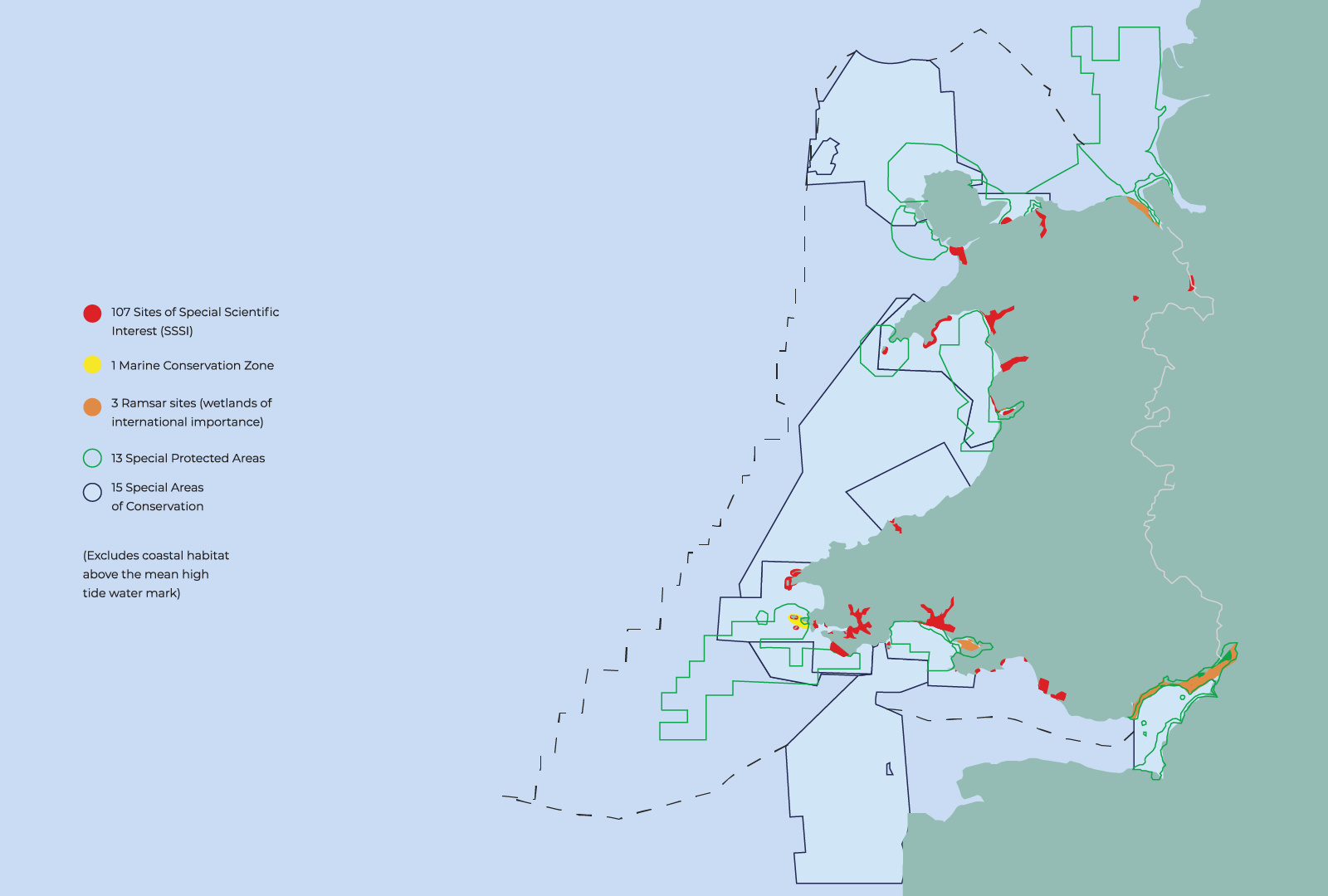
The image is a map of Wales and the surrounding waters showing designated marine and conservation sites.
The legend identifies the following designations:
- 107 Sites of Special Scientific Interest (SSSIs), shown in red
- 1 Marine Conservation Zone, shown in yellow
- 3 Ramsar sites (wetlands of international importance), shown in orange
- 13 Special Protected Areas, shown with green outlines
- 15 Special Areas of Conservation, shown with dark blue outlines
The mapped designations are distributed around the Welsh coastline, including north Wales, Cardigan Bay and the south Wales coast. Several designations extend offshore into marine waters.
A dashed boundary line marks the wider marine planning or jurisdictional boundary around Wales. The note on the map states that habitat above the mean high tide water mark is excluded. The image demonstrates the concentration and distribution of protected marine and areas around Wales.
Climate Adaptation Strategy for Wales
The Climate Adaptation Strategy for Wales aims to keep land-based, freshwater, marine and species and habitats in good ecological health and resilient to the impacts of . The strategy also covers infrastructure, flooding and adaptation approaches.
This includes:
- Keeping protected areas in favourable conditions
- Increasing habitat diversity, extent, connectivity and species-richness across all areas. This leads to more resilient ecosystems and fewer greenhouse gas emissions from natural stores (places in nature that can absorb and hold for a period of time)
- Using more , which are outlined in more detail in chapter 4.
National Strategy for Flood and Risk Management in Wales
This sets out a comprehensive approach and long-term measures for reducing the risk of flooding across Wales.
The strategy:
- Provides strategic direction through clear objectives and measures that help to reduce risk by building an area’s and encouraging collaborative working
- Focuses on delivering more sustainable schemes via and coordinated land and water planning
- Recognises the importance of clear advice on for Risk Management Authorities (see above) and communities, and the need to work closely with groups on shoreline management plans.
Shoreline management plans
Shoreline management plans help communities prepare for the changes ahead. It’s about building , so when flooding does occur, we can learn to respond and recover quickly to reduce the chances of negative long-term effects.
Who’s involved?
Risk Management Authorities whose members include Welsh Government, Natural Resources Wales, local authorities (acting as Lead Local Flood Authorities) and water companies with a responsibility or interest in managing the coast then help to deliver the aims of the National Strategy for Flood and Risk Management in Wales for Government.
The Welsh Groups’ Forum – made up of groups with interest in the coast – then create the shoreline management plans (there are four that cover Wales), and oversee their production and quality. Shoreline management plans are owned by groups, and signed off and approved by Welsh Government. In the Dyfi, we’re part of the West of Wales Group which includes local authorities (Gwynedd, Conwy, Ynys Môn, Ceredigion and Pembrokeshire), Natural Resources Wales, Network Rail and other maritime operating organisations. The group manage the shoreline between St Anne’s Head in Pembrokeshire and the Great Orme in Conwy.
To learn more about adaptation and Shoreline Management Plans, see Chapter 5.